Author’s Note: this post started as a preamble to the Louis Moinet Chronograph build. In the course of writing, it took on a life of its own and became an introspection I wasn’t expecting. I don’t fully know how I feel about what came out, only that it’s honest. In the spirit of Exposure, it’s here.
My watch collection started in first grade with a Ninja Turtles digital watch — a post-tonsillectomy prize (along with all the popsicles I could stomach) that made me the undisputed coolest kid on my block. Michelangelo and his nunchucks on the faceplate, a flip-open lid, two buttons to set the time. It was accurate. I wore it nonstop. Thirty years later, my parents still have it somewhere in their basement, which tells you something about immigrant parents: nothing gets thrown away, because everything was hard to get.
For a few years after that, I needed my wrists free. Monkey bar chicken fights, army crawling with Nerf guns, pretending not to hear my mom calling me in for dinner — a watch would’ve just gotten in the way. But by eighth grade, a disappointing growth spurt had left me somehow smaller than everyone, including the girls, and I decided I needed to be taken more seriously. I wanted a “watch with hands and glow paint.”
I begged my parents. Extra chores. Unprecedented kindness to the local demonic possession known as “my little sister.” Harder work on my grades — no small feat when you’re the son of immigrant parents: “why not A+” wasn’t a punchline in our house. It was daily dinner conversation.
After weeks of persistence, I went all in and set up the ultimate bargain: in lieu of a birthday present, and with a promise to win the eighth grade spelling bee, my parents would allow me to pick out a watch (within a range they approved) and they would pay for it.
We weren’t well off. I always sort of understood that: the careful grocery shopping at the store across town far from where my classmates shopped, clothes only from the discount rack and slightly too big so I could grow into them, the bananas that were closer to “nature wrapped gels” than solid fruit, but still good to eat.
But I understood something else too: my parents were teaching me, probably without knowing it, that the niceties of life, like a watch, are something you earn and not given or guaranteed. Everyone has a birthday: it’s nothing special. Hard work and delivering on your promises — that earns the kind of life we sacrificed for. And then, yes, choose how you wear the proof of it.
I won the spelling bee. Under those expectations, who wouldn’t?
We went to Macy’s that weekend, and I got my first big boy watch: a small stainless steel Fossil — probably a 28mm case — with an integrated linked bracelet painted with a faux gold center link and of course, glorious Mountain Dew lumed hour and minute hands. The SKU tag read $50, which to me was a fortune so large it made my stomach turn and I tried to change my mind and back out. My mom had to calm me down with the only logic I could understand: “don’t worry, I get half off with my employee discount.”
I spent the next week saluting my glinting wrist at the sun and then ducking into the darkest closet in the house to watch the hands glow. I carefully rolled up every oversized, ill-fitting, hideously patterned Goodwill and cousin-handed-down shirt I had just to show off that weighty metal at school. Looking back, it may have been a women’s watch: I was a small kid and I didn’t know there was a difference. But it didn’t matter: a quarter inch of steel on my wrist and suddenly I existed differently in the world. I was a champion, an analog watch wearer, looked up to instead of down upon.
I never stopped chasing that feeling, and watches have continued to be a reliable provider.
Over the years that followed, I rifled through celebrity magazines at checkout lines and watched movies when I could. Not for the gossip or the art, but to see the watches. I checked wrists when out in public and would ask: “what’s the story?” and latched onto the deep emotions when wearers revealed what the watch meant to them. The sacrifices they made to get to where they were, the “I finally made partner” pride, the catch in the throat of “this was my father’s when he served in Vietnam”, the “I beat cancer and hiked Kili” triumph stories.
What I was really studying was what a watch says. Not about money — about orientation and values. A watch says: I know where I am in time. As a kid from an immigrant family where every day was a struggle for survival and establishing our place, a watch was a sign of weathering the storm. The path to getting there was the simple but hard lessons from my parents: be where you said you’d be, do what you said you’d do, and this country would unlock wonders.
Watches were life stories displayed proudly. And I wanted to commemorate every chapter of mine.
My own collection grew slowly, and every piece marked something real.
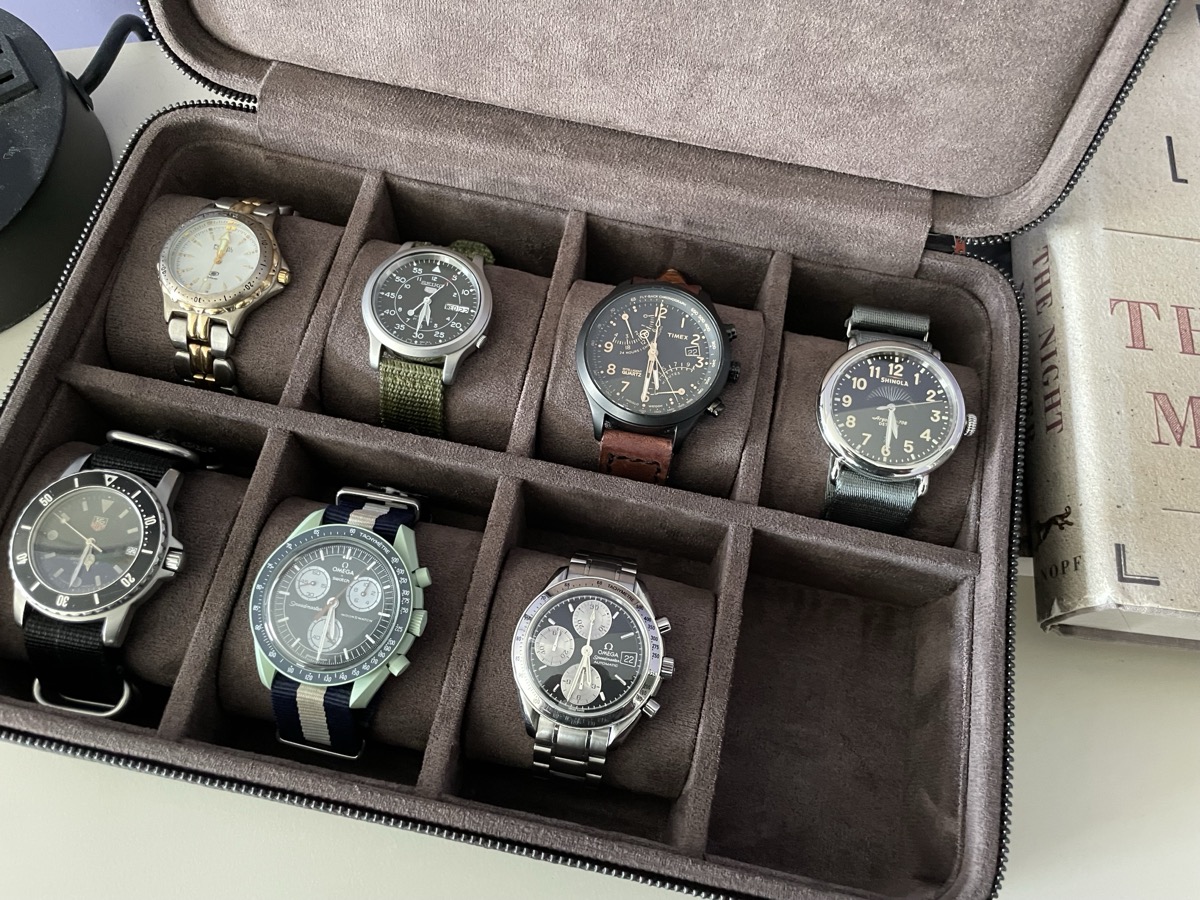
A Timex Flyback Chronograph after getting accepted to an Ivy League school — the first proof that the spelling bee kid might actually pull this off. Also, that glow!
My first automatic: a green dial Seiko 5. I still remember the first time I held it to my ear and heard the rotor spin. No battery. No external power source. Just physics, doing its patient work. There’s something about a mechanical watch that appeals to anyone who has ever had to make something from nothing. The movement doesn’t care about your circumstances. If you move, it moves. And with 20 credits a semester on a premed track, intramural sports, student volunteering, and two student jobs, I was always moving.
A Tag Heuer Professional on a heavy NATO strap that stayed on my wrist through a world-traveling phase — quartz movement under a sapphire dome and a crisp clicking unidirectional bezel made sure I showed up sharp, on time, and prepared in a job where every second could be life or death. That watch was armor.
A Shinola Runwell Moonphase — nearly a decade later, I transitioned careers into consulting and restarted from absolute beginner, back of the pack to my peers. This watch was a quiet celebration when I crossed my self-imposed mental threshold of “respectable adult” salary. I’d doubled down and caught up. A modest but elegant grown-up watch.
A Swatch Moonswatch Mission to Earth — to commemorate my first “work hard, play hard” vacation in my 30s. I splurged with a bespoke travel service where every detail was meticulously tailored to me. I followed a tarantula wasp in a rainforest, hand-ground coffee beans and brewed the best cup of my life, and crossed off a bucket list scuba dive. That trip is now a barometer for self-care: a skill I never learned growing up.
And recently, my first Omega Speedmaster. Not the grail Moonwatch, but a Speedmaster Reduced with panda dials. My flag in the ground owning my uniqueness and who I am. It’s not the recommended choice or “what you’re supposed to get”. But it’s solid, accurate, a little smaller than everyone else, and feels so very me.
Like I’ve finally arrived. Like I’m finally in control of my story and who I am.
To me, horology is a hard promise kept: keep powering on and it will keep moving. Just like that trusty Seiko 5. To someone who grew up watching their parents build something from nothing through sheer reliability and dedication: that philosophy embeds deeply.
That $50 Fossil still sits in my watch box. I see it every morning, scratched and scuffed. Thirty years later, the chain no longer fits over my hand, but the lessons of it have stayed perfectly tailored to the man I’m proud to have grown into.
Be on time. Keep your word. Earn your story.
A watch is your time, captured.