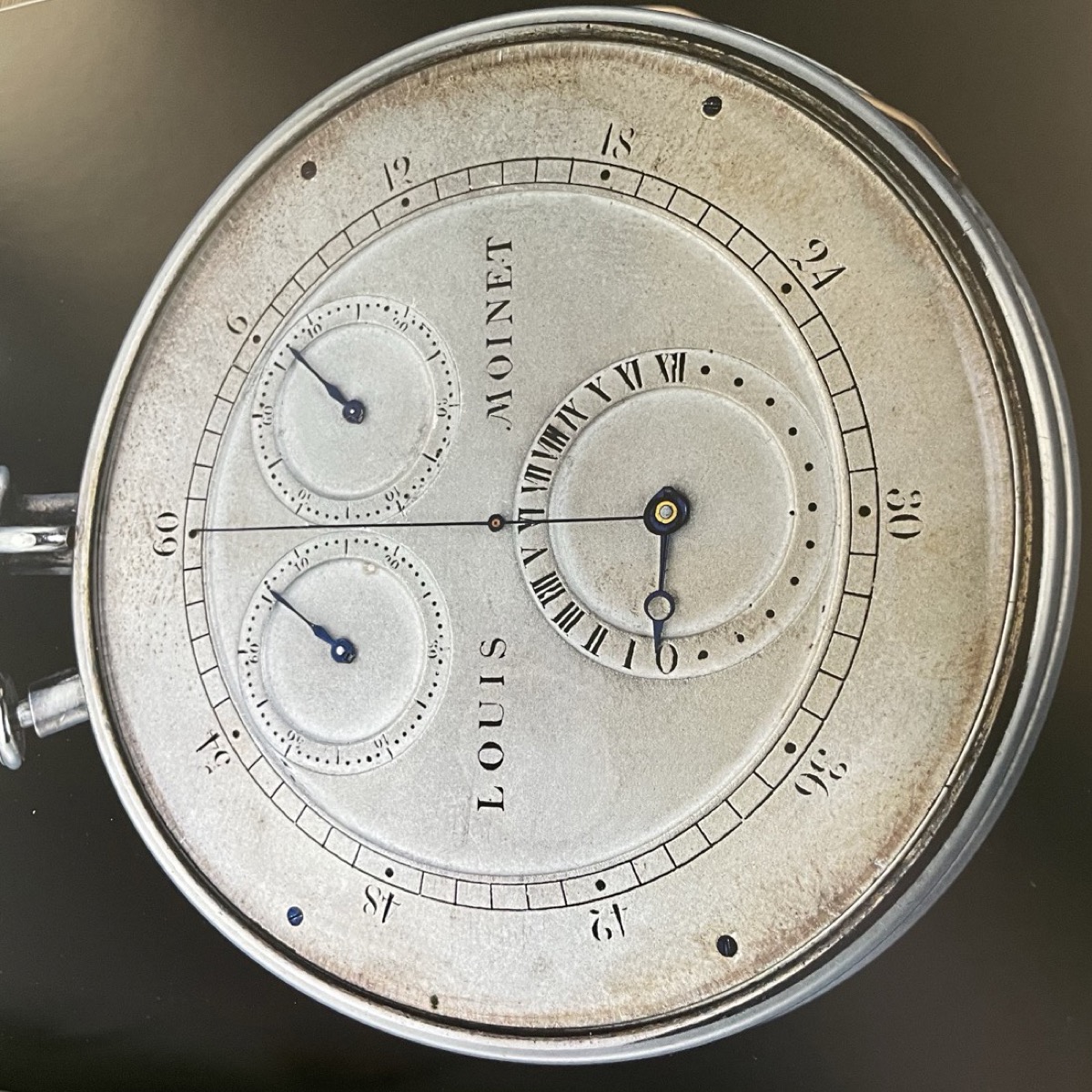
LOUIS MOINET
NEUCHÂTEL / BOURGES
Compteur de Tierces
The first chronograph. Lost for two centuries.
The first chronograph. Lost for two centuries.
§ I · A SILENCE OF 200 YEARS
In 1816, a French watchmaker
built a device so precise,
so far beyond the engineering
of his century, that the world
would not catch up for
two hundred years.
It was lost. Then it was found. And when a panel of horologists at the Observatoire de Neuchâtel opened its case in the spring of 2013, they rewrote the history of modern watchmaking.
To time a star crossing the meridian, you need to resolve less than a second. In 1816, no instrument could do that. Moinet built one that could.
Louis Moinet did not build a watch for a wrist. He built an instrument for an observatory. In 1816, the unsolved problem that drove the best European astronomers was not where a star was — it was when a star was. A telescope trained on the meridian — an imaginary north‑south line overhead — is watching for a single moment: the instant the star crosses it.
That instant, read against a clock, fixes longitude. It sets the marine chronometer of every ship leaving a port that night. The limit of the method had always been the clock: the crossing lasts less than a second, and no pocket watch in 1816 could resolve anything smaller.
Moinet's answer was the Compteur de Tierces — the counter of thirds. A tierce is one‑sixtieth of a second. To resolve one, a balance must oscillate 30 times every second. In 1816, the state of the art was 4. Moinet leapt past an entire century of watchmaking in a single workshop year.
Horological history names its firsts by paper trail. When the paper goes missing, the history is wrong for as long as the object stays lost.
Louis Moinet finishes the instrument in his workshop. He writes up the mechanism in a technical treatise but never commercializes it.
Nicolas Rieussec patents his "seconds chronograph" — the inked-drop timer taught as the first chronograph for two centuries. In 1862, Adolphe Nicole will patent the return-to-zero reset. Moinet had already solved both, in the same workshop year.
The Compteur de Tierces appears in a private auction at Christie's. It is bought by Jean-Marie Schaller, owner of the revived Louis Moinet marque.
On 21 March 2013, a panel of horologists at the Observatoire de Neuchâtel opens the case. The beat rate is measured. The mechanism is documented. Guinness World Records recognises it as the earliest known chronograph — and the first high-frequency stopwatch.
Horology textbooks are slowly catching up. The Compteur de Tierces now stands as the origin point of chronography — five years earlier than every book had said, and two centuries ahead of its own era's frequency.
Scroll to disassemble. Six layers, each solving a different constraint of high-frequency timekeeping.
To resolve one tierce — one-sixtieth of a second — a balance must oscillate thirty times every second. Nothing else in 1816 came close.
The column-wheel — the mechanism every chronograph is said to need — was not patented until 1862. Moinet did without it. Instead, he built a shuttle that acts directly on the balance and the escape wheel.
At one end: tierces — one-sixtieth of a second. At the other: hours. One dial built to hold a full night of observation without losing its finest division. Hover to read.